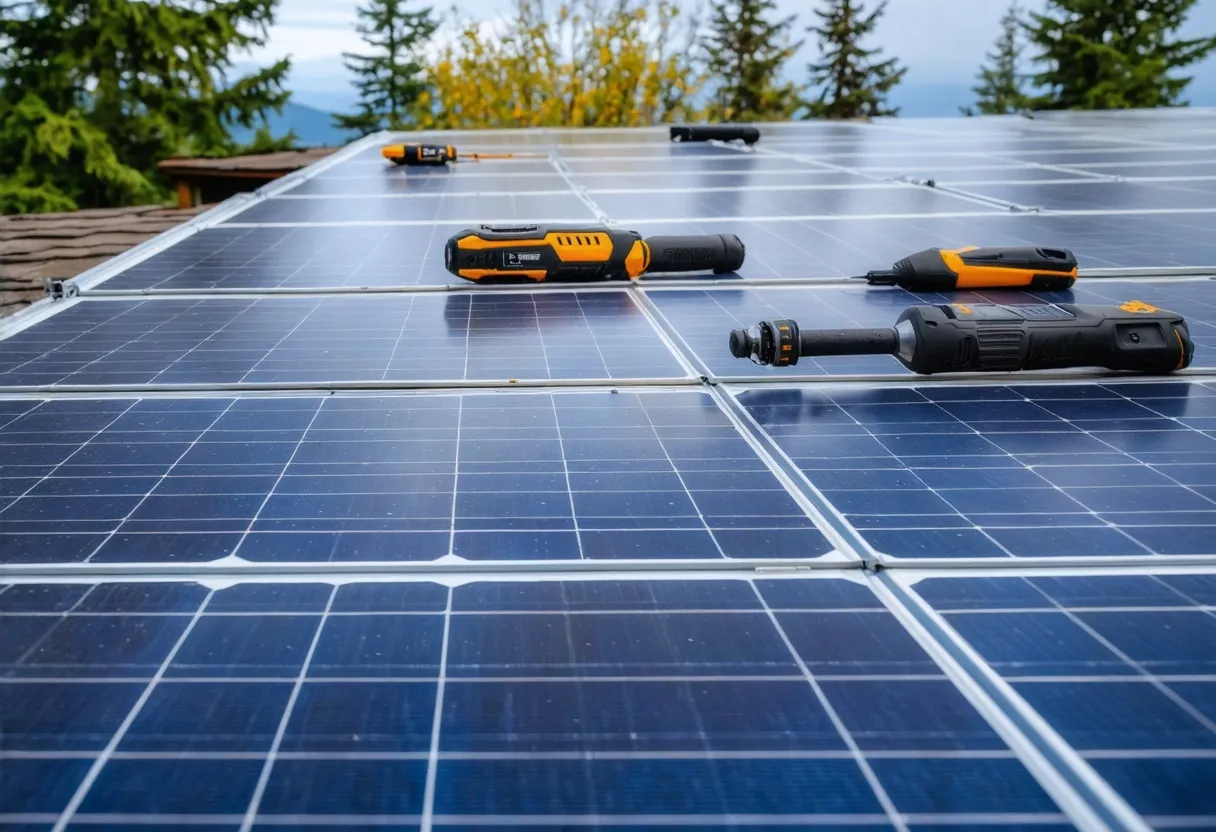
Anchorage sits north of the 61st parallel, and that single geographic fact turns off-grid solar into a fundamentally different engineering problem than the same system built in Seattle, Denver, or anywhere in the Lower 48. Winter days shrink to five or six hours of daylight around the solstice, much of it arriving at a low sun angle that produces far less usable energy per hour than a July afternoon does, and a poorly mounted array can sit buried under snow from December through March while it should be producing power. Off-grid solar in Anchorage isn't a scaled-down version of a standard grid-tied rooftop install — it's a power system that has to survive the worst two months of the year, not the annual average, and the systems that fail here almost always failed because they were sized for a sunnier month than the one that actually matters.
That principle runs through every off-grid or remote project we design, whether it's a year-round cabin off the road system, a hunting or fishing property with no utility line within reach, a full-time residence built for genuine independence from Chugach Electric, or a grid-tied home adding battery backup against Railbelt outages. Size the array and battery bank against December, not July. Engineer the mounting and tilt angle to shed snow rather than collect it. Build in enough stored capacity to ride out several overcast days in a row without a generator running around the clock. Get those three decisions right at the design stage, and permitting, equipment selection, and commissioning follow from them instead of fighting against them.
Is Your Property a True Off-Grid Candidate, or Does It Need Grid-Tied Backup Instead?
Sizing for December, Not July: How We Engineer an Off-Grid System for Anchorage
The Six-Hour Day Changes the Math
Around the winter solstice, Anchorage gets under six hours of daylight, and much of that light arrives at a low sun angle that produces far less usable energy per hour than a July afternoon does. A load calculator built on national average sun-hour data will show a comfortable margin on paper and then leave you running a generator every night from November into February. Worst-month sizing means running the array and battery numbers against Anchorage's actual December and January solar resource — not the annual average — because that is the only test that actually predicts whether a system will carry your household or cabin through the darkest stretch of the year, rather than just looking adequate in a summer proposal.
Storage Does More Work Than Panel Count
In a low-daylight climate, battery capacity buys flexibility that more panels simply can't. A bigger array only helps on the handful of days that actually deliver clear winter sun; a properly sized battery bank lets you bank whatever those clear days produce and spread it across the two or three overcast days that typically follow, which is the normal Anchorage winter weather pattern rather than an edge case. That's why an off-grid proposal built around usable battery capacity in kWh — not just panel wattage — is the one worth taking seriously, and why we design the bank first and the array second.
Cold Panels, Warm Batteries
One detail that surprises a lot of first-time off-grid owners: solar panels are actually more efficient in cold temperatures than in heat, so the panels themselves aren't the weak point in an Anchorage winter — available daylight is. Batteries are the opposite story. Lithium iron phosphate battery banks need to stay above freezing to charge safely and to avoid permanent capacity loss from repeated cold-charge cycles, which is why insulated enclosures and, in unheated sheds or remote cabins, a small heating element are standard parts of a properly designed off-grid battery setup here rather than an optional upsell.
Snow Load and Tilt Angle Aren't Cosmetic Choices
Racking has to be rated for local snow accumulation, and tilt angle has to be steep enough to help panels shed snow instead of holding it through the winter. Where the site allows it, we favor ground or pole mounts that stay reachable for manual clearing after a heavy dump, because an array buried under snow for weeks isn't an equipment failure — it's a mounting decision made without winter in mind, and it's avoidable at the design stage rather than something you live with afterward.
Why Generator Sizing Follows the Battery Bank, Not the Other Way Around
A backup generator in a hybrid off-grid system exists to fill the gap between what the battery bank can reasonably carry and the absolute worst-case stretch of dark, overcast days. Size the generator first and you end up either running it constantly or oversizing the battery bank to compensate; size the battery bank against realistic autonomy targets and let the generator cover the tail end, and you get a system that runs quietly most of the year and only calls on fuel when it genuinely needs to.
What an Off-Grid or Remote Solar Build Actually Looks Like, Start to Finish
We go through every appliance, pump, and heating circuit you actually intend to run and walk the property itself for roof or ground-mount orientation, terrain shading, and trail or road access before any equipment gets specified, because oversizing wastes money and undersizing means running a generator every night.
Array size, usable battery capacity, and generator backup are sized against Anchorage's worst-month solar resource and your real load profile rather than an annual average that looks fine on a proposal and comes up short in January.
True off-grid installs typically move through a straightforward electrical permit with the Municipality of Anchorage or the relevant borough, while hybrid and grid-tied systems add Chugach Electric interconnection paperwork on top of that step.
Panels, racking, batteries, and generator equipment are staged and installed around weather windows, which matters far more for trail- or boat-access sites than for an in-town rooftop where a delivery truck can pull up to the door.
Once the system is tested under load, you get a walkthrough of how to read battery state of charge, when a generator will auto-start if one is installed, and what seasonal maintenance — mainly snow clearing and connection checks — looks like through an actual Anchorage winter rather than in a manufacturer's demo.
Engineered for an Anchorage Winter, Not a Denver Brochure
Every off-grid and remote system we design starts with Anchorage's own winter daylight and snow-load numbers, not a national sizing chart borrowed from a warmer climate. If a design can't be shown to carry your actual load through December and January, it isn't finished yet — no matter how good it looks on a summer sales sheet.
Which Anchorage-Area Properties Actually Need a True Off-Grid Build
Not every property near Anchorage needs the same answer, and the honest first question in any site assessment is whether full independence is even the right goal. A cabin along the road system that already has utility service nearby is usually better served by a grid-tied system with battery backup than by going fully off-grid — you get outage resilience and net-metering credit through Chugach Electric without oversizing an array and battery bank to cover every possible scenario yourself. True off-grid design earns its cost on parcels where a utility line simply isn't realistic: remote lots reached by trail or boat, hunting and fishing cabins well outside grid range, or year-round residences where a utility extension quote ran into five or six figures before a single panel gets ordered.
Once a project is genuinely off-grid, several subsystems get engineered separately rather than folded into one household load calculation:
- Water pumping and well systems are usually wired as a dedicated DC or small AC subsystem, since pump motors have different surge and duty-cycle demands than lighting or electronics and can otherwise distort the whole load profile.
- Communications and safety loads — satellite internet, radios, security lighting — typically sit on a protected circuit so they stay powered even if the household battery bank has drawn down during a stretch of low sun.
- Seasonal-use cabins can often run a smaller array and battery bank than a year-round property, since the heaviest use — summer — lines up with the best solar resource, and the system can be allowed to fully deplete during an unoccupied winter stretch without consequence.
Terrain matters almost as much as latitude once you're outside the Anchorage bowl. A rooftop array on a home off Ingra St., for example, gets a fairly predictable shading and snow-shed picture from a standard site assessment. A property near Turnagain Arm or in the mountain corridor southeast of the city deals with terrain shading and microclimate effects that change the assessment entirely — mountain shadow can cut usable winter light well beyond what latitude alone would predict, and that has to be measured on-site rather than assumed from a map or a shading tool built for flatter terrain.
Cost follows the same logic as the engineering. On a true off-grid build, the battery bank is usually the single largest line item, often exceeding the panels themselves, and site access adds real labor and equipment-staging cost on a trail- or boat-access parcel that an in-town rooftop simply doesn't carry. Adding a generator and automatic transfer switch increases upfront cost but can reduce how much battery capacity you actually need to buy, which nets out as a savings depending on usage pattern — and a phased approach, installing the array with a smaller starter battery bank first and expanding storage in a second phase, is common for off-grid cabins where a generator can carry more of the load in year one.
Solar itself isn't a novelty in this market, which matters when you're vetting who designs and installs yours. The Municipality of Anchorage operates its own rooftop solar array, and the Anchorage Solarize program has previously organized group-purchase pricing and awareness for residential solar around the municipality — program terms and availability shift from year to year, so it's worth asking an installer what's currently active rather than assuming a past round still applies to your project. What that local history tells you is that the permitting, inspection, and interconnection process here is a known, regularly walked path for someone actually based in this market, not unfamiliar territory.
Off-Grid Solar Questions Anchorage Property Owners Ask
Can a cabin with no grid connection actually run through an Anchorage winter on solar alone?
Yes, if the array and battery bank are sized around Anchorage's worst-month daylight rather than an annual average, and in most year-round off-grid homes that means pairing the system with a backup generator sized to cover extended low-light stretches from roughly November through February.
How much battery storage does a remote Alaska property actually need?
It depends on your load and how many consecutive low-sun days you want to ride through without the generator running — a seasonal cabin used mainly in summer can often get by with a modest bank, while a year-round remote residence needs enough capacity to bridge several overcast winter days in a row, which gets calculated during the site and load assessment rather than pulled from a generic size chart.
Do I need a backup generator if I go off-grid in Anchorage?
Most year-round off-grid systems here include one, because it lets the battery bank be sized for normal winter cycling instead of the absolute worst-case scenario — a generator that runs occasionally as insurance is usually cheaper overall than a battery bank large enough to never need one.
What permits apply to a fully off-grid system on a remote parcel?
True off-grid installs typically move through a standard electrical permit process with the Municipality of Anchorage or the relevant borough, which is generally simpler than the interconnection paperwork required for a grid-tied or hybrid system connected to Chugach Electric.
What's the real difference between off-grid and grid-tied with battery backup?
A fully off-grid system has no utility connection and has to cover 100% of your load year-round using solar, battery, and typically a generator, while a grid-tied system with battery backup stays connected to Chugach Electric, uses net metering to offset usage, and leans on the batteries mainly for outage protection rather than total independence — off-grid earns its cost where there's no practical utility access, and grid-tied with backup usually makes more financial sense where service already
How cold does it have to get before batteries stop working?
Lithium battery banks need to stay above freezing to charge safely, so the concern isn't a single cold snap but sustained sub-freezing exposure without insulation or heating — that's why enclosure insulation and, in unheated or remote installations, a small heating element are standard parts of a properly designed off-grid battery setup in this climate rather than an optional add-on.
Request your free quote
See what a winter-ready system would look like on your home, with no pressure to move forward.
Get a system built for Anchorage winters
Reach out for a no-obligation quote sized to your roof and this climate.